

Innovative Digital Solutions for SMBs
Website too slow? See the real causes and how a custom-built website helps SMBs load fast and win more business.
You've spent time and money getting your website looking sharp. The copy is on point, the photos are professional, and the branding is consistent. But if your site takes more than a few seconds to load, chances are potential clients never see any of it — they've already clicked away.
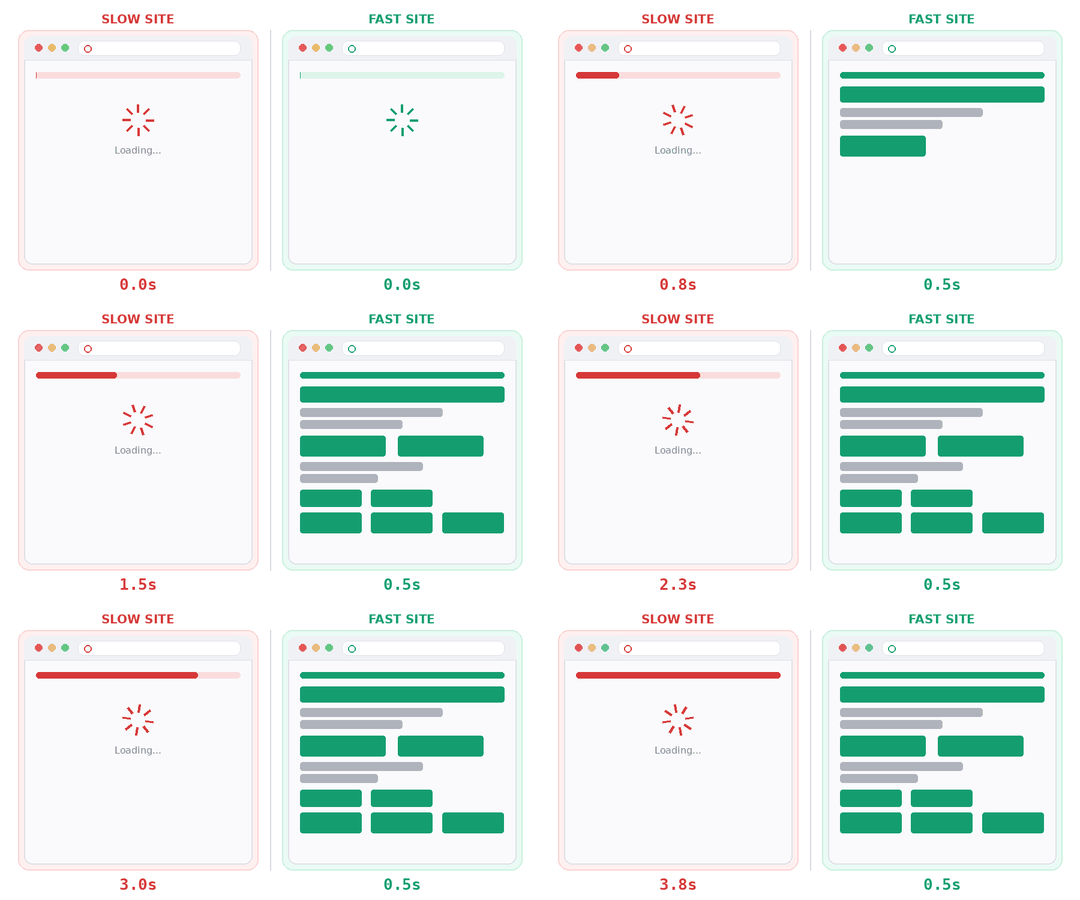
For small and medium-sized businesses, a slow website is one of the most common — and most fixable — reasons a website underperforms. Let's break down why speed matters so much, how to tell if it's costing you, and what you can do about it.
Think about your own browsing habits. If a page doesn't load almost instantly, do you wait patiently, or do you hit the back button and try the next search result?
Most visitors behave the same way. Research on user behavior consistently shows that as load time increases, so does the likelihood someone abandons the page before it even finishes rendering. A site that takes five seconds to load will lose a meaningful chunk of visitors who never stick around long enough to read a single word.
For an SMB, that's not an abstract metric — it's a lost quote request, a missed booking, or a sale that went to a competitor instead.
Slow websites don't just frustrate people; they quietly damage credibility. A page that lags, stutters, or shows broken layouts while loading can make even a well-established business look outdated or unreliable. Clients often make snap judgments about professionalism based on how a site feels to use, long before they read your About page.
This is especially important for service-based businesses — law firms, clinics, contractors, consultants — where trust is the entire sales pitch. A slow, clunky site undercuts the very credibility you're trying to build.
Load speed isn't just a user experience issue — it's a visibility issue too. Search engines factor page speed and overall site performance (often referred to as Core Web Vitals) into how they rank pages. A slow site can end up buried below faster competitors, even if your content and services are better.
In other words, a sluggish website can hurt you twice: once by pushing you down in search results, and again by driving away the visitors who do make it to your page.
Most SMB websites aren't slow because of one big problem — it's usually a handful of small ones stacking up:
Individually these might shave off a fraction of a second. Together, they can turn a one-second load into a five-or-six-second wait.
If your site is built on WordPress, there's a good chance several of these issues are baked in from the start. WordPress relies on a stack of plugins to do things that should be simple — a plugin for forms, a plugin for SEO, a plugin for speed (yes, really), a plugin to manage the other plugins. Each one adds its own code, its own database calls, and its own way of quietly slowing the page down.
It's not that WordPress can't be made fast. It's that doing it properly takes constant, specialised maintenance most SMBs don't have the time or budget for — and most agencies don't provide once the site is handed over. That's why so many WordPress sites get slower and slower as more plugins and updates pile on.
This is exactly why we don't build on WordPress. We build custom, lightweight sites with only the code your site actually needs — nothing bolted on, nothing dragging you down as your site grows.
The good news: most website speed problems are solvable without a full site rebuild.
Some of these are quick wins you can do yourself this week. Others — like moving off a plugin-heavy platform or rebuilding on something leaner — are best handled by a team that builds websites this way from day one, rather than bolting fixes onto an already slow foundation.
A beautiful website that loads slowly is still a slow website — and slow websites lose clients, regardless of how good the design looks once it finally appears. For SMBs competing for attention against bigger brands with bigger budgets, speed is one of the few areas where a smart, well-built site can genuinely level the playing field.
Speed isn't something you can bolt on at the end. It comes from how a site is built in the first place — which is why we build every site from scratch with clean, custom code instead of stacking plugins on top of a template. No bloated platform to fight against, no speed plugin trying to undo the damage of five other plugins. Just a fast, reliable site built to stay that way.
If you're not sure how your current site is performing, that's the first thing to find out. And if it turns out speed — or the platform it's built on — is holding you back, replacing it is often one of the most cost-effective moves you can make for your business.
Curious how your site stacks up? Get in touch for a free website speed check — we'll show you exactly what's slowing you down and what a custom-built website could do instead.
Tags: website speed load speed slow website wordpress problem